Buffing Wheel OEM Sourcing & Wholesale
Shanghai-based B2B sourcing and OEM project support for cotton buffing wheels, spiral-stitched wheels, airway buffs and polishing compounds. The proposed production source, specification, inspection scope, evidence, MOQ and terms are confirmed for each quoted SKU.
Need detailed specifications? See cotton buffing wheel specifications.
Compare Buffing Wheel Constructions Through a Documented Sourcing Process
SCOTTCHEN supports buffing wheel and polishing accessory sourcing projects from Shanghai, China. The quoted scope can cover cotton wheel construction, matched compounds, adapters and retail packaging for distributors, tool brands and industrial polishing buyers. The responsible production source and inspection scope for each component must be identified in the quotation.
Industrial buyers require more than a wheel name: density, arbor fit, rated speed, construction and compound pairing must be explicit. The approved sample and quality plan should define balance, ply count, bore tolerance and any application-specific acceptance checks before an order is released.
Distributors can request a quotation that separates wheel construction, compound selection, packaging, barcode data, MOQ assumptions and sample validation. Specialized or regulated applications require buyer-defined performance and documentation requirements; suitability is not established by a general website description.
Product Types & Wholesale Configurations
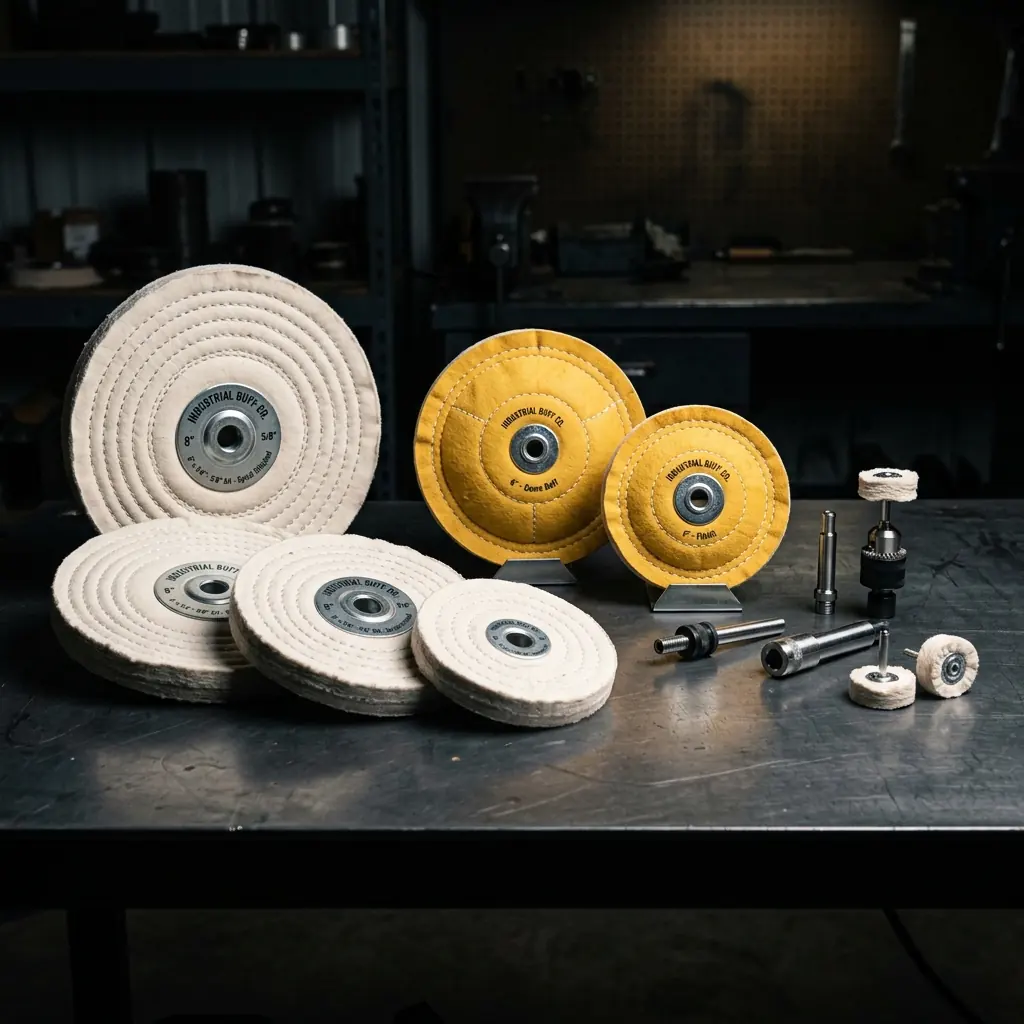
Spiral Stitched Cotton Buffs
Spiral or concentric stitching is commonly used to hold cotton layers together for cutting and intermediate polishing steps. Buyers can compare cloth grade, ply count, stitch pattern, density, bore, rated speed and the target substrate through a proposed-source sample test.
- Common RFQ field: ply count and finished thickness
- Common RFQ field: stitch pattern and spacing
- Common RFQ field: diameter, bore and machine interface
- Cloth grade and thread specification: confirm by SKU
Loose Section Cotton Buffs
Loose-section wheels use limited center stitching so the cloth face can flex during a coloring or final-polish step. Surface result, heat behavior and compound pairing depend on the quoted construction, machine settings and workpiece, so approval should be based on a controlled sample test.
- Common materials: muslin, flannel or other specified cloth
- RFQ field: center stitching and finished density
- Compound pairing: validate on the target substrate
- Bore, rated speed and acceptance criteria: confirm by SKU
Airway / Ventilated Buffs
Airway and ventilated constructions use pleated sections intended to move air through the wheel. They may be evaluated for continuous polishing lines where heat management matters, but cooling, life and output must be verified for the proposed source, wheel size, hub and operating conditions.
- RFQ field: pleat count and section construction
- RFQ field: diameter, hub, bore and machine interface
- Rated speed: source document and SKU approval required
- Heat and service-life comparison: validate by sample test
Sisal-Cotton Treated Buffs
Sisal, sisal-cotton and treated constructions are commonly considered for an initial cutting step before finer cotton-wheel stages. Fiber composition, treatment chemistry, density, compound compatibility and achievable finish vary by source and must be documented and sample-tested for the application.
- Fiber composition and treatment: confirm by SKU
- Construction and density: state in the approved sample
- Compound pairing: test on the buyer's workpiece
- Performance and wear criteria: agree before order release
Bench Grinder Polishing Wheel Kits
A proposed kit can combine wheels, compounds and adapters for a defined bench-grinder interface. Machine compatibility, rated speed, sequence and safety information must be checked against the buyer's equipment, while packaging and barcode placement follow buyer-supplied channel requirements.
- Wheel diameter, bore and adapter: confirm against the machine
- Sequence and compound pairing: approve by sample test
- Packaging format: quoted by SKU and order quantity
- Buyer-supplied UPC/FNSKU data and carton marks: approve in artwork
Drill-Mounted Buffing Sets
Shank-mounted formats are commonly used to reach recesses and contours that a bench-mounted wheel cannot access. A sourcing quote should identify shape, cloth or felt construction, shank geometry, tool compatibility, rated speed and the proposed production source for every component.
- Common RFQ field: shank type and dimensions
- Common shapes: cylinder, cone, dome, mushroom and T-shape
- Kit composition and compound pairing: quoted by SKU
- Tool compatibility and rated speed: buyer approval required
Polishing Compound Bars
Compound color alone does not define abrasive chemistry or suitability. An RFQ should state abrasive type, particle range, binder, bar weight, target substrate, safety-document requirements and packaging, followed by a sample comparison with the selected wheel construction.
- Formula, grit and binder: confirm by SKU
- Bar dimensions and net weight: state in quotation
- Safety and composition documents: identify by source and market
- Wrapper, label and retail pack-out: approve as artwork
Wholesale RFQ Comparison Matrix
| Procurement field | Buyer should provide | Confirm in quotation | Approve before order |
|---|---|---|---|
| Wheel construction | Workpiece, target process and desired cut or finish | Proposed source, construction and inspection scope | Approved sample and SKU record |
| Tool fit | Machine, bore or shank, guard and operating data | Compatibility basis, label evidence and test scope | Fit and safe-use checks |
| Compound pairing | Substrate and finish target | Formula or source evidence and pack requirements | Representative workpiece test |
| Packaging | Channel, artwork, labels, barcode owner and quantity | Materials, pack-out and approval route | Approved packaging specification |
| Commercial terms | Quantity, destination and target timing | MOQ, milestones, Incoterms and exclusions | Dated quotation or contract |
This is a comparison checklist, not a stock catalog or performance commitment. The quoted production source must confirm the final construction, operating information, test method and supporting evidence for each SKU before buyer approval.
Applications
How to Evaluate a Buffing Wheel Quote
Balance & Bore Criteria
Put the balance method, bore tolerance, rated speed and acceptance sample into the written SKU specification.
Documented Quality Plan
Confirm incoming, in-process and final inspection scope, sampling level and records for the quoted configuration.
Wheel and Compound Pairing
A quoted scope can pair proposed wheels and compounds, with the source, formula, sequence and sample result documented by SKU.
OEM & Private-Label Scope
Proposed ply configurations, branded packaging, blister cards, color boxes and buyer-supplied barcode data can be evaluated and quoted.
Channel-Specific Packaging
Document polybag, warning, barcode and carton requirements against the buyer's current retailer or marketplace rules.
Application Review
Any technical support, custom construction or multi-step sequence is defined in the written project scope and validated on buyer-approved samples.
OEM / Private-Label Sourcing Scope
SCOTTCHEN supports OEM and private-label sourcing projects for distributors, importers, tool brands and e-commerce sellers. A proposed scope may compare cloth types, ply counts, stitch patterns, bores and compounds, but the responsible production source, material specification, sample fee, MOQ, evidence and commercial terms are confirmed in the SKU quotation.
Private-label packaging options can include industrial cartons, color boxes, hang-tag blister cards, heat-shrink polybags and clamshells. Logo files, specifications, translations, warnings and barcode data remain buyer-controlled inputs; the approved artwork and current channel rules determine the final pack-out.
A project can follow this documented sequence: buyer specification and target market, proposed-source quotation, sample and evidence review, artwork approval, order confirmation, production and inspection, then shipment. Any consultation, sampling, kitting or retail-display work is included only when stated in the written quotation and approved project scope.
Frequently Asked Questions
Q1:What is the minimum order quantity for wholesale cotton buffing wheels?
Order quantity is confirmed per size, ply, construction and packaging format. Standard configurations may support smaller evaluation orders, while custom constructions, printed packaging and mixed kits can require higher setup quantities. Ask for the MOQ assumptions to be stated on the SKU-level quotation.
Q2:How long is the typical lead time for buffing wheel production?
Lead time is quoted after the wheel construction, quantity, sample status, artwork and packaging process are confirmed. The written quotation should separate sample approval, artwork approval, production and shipment milestones rather than relying on a generic website estimate.
Q3:Can a buffing-wheel sourcing quote include matched compound bars?
A quoted sourcing scope can include compound bars alongside buffing wheels. The proposed production source, formula, grit, binder, bar weight, safety documents, packaging and wheel pairing must be confirmed by SKU and approved through sample testing; color names alone are not a performance specification.
Q4:How should buyers specify an arbor hole for a polishing wheel?
Common RFQs reference dimensions such as 1/4", 3/8", 1/2", 5/8", 3/4", 1" or 1-1/4", but none should be assumed compatible from the website alone. State the machine spindle, bore tolerance, insert or washer construction, wheel diameter and rated speed; the proposed source and approved sample must confirm the final SKU.
Q5:How should balance and rated speed be verified for a buffing wheel?
Balance, bore tolerance, rated RPM and the inspection method should be written into the approved SKU specification. For large-diameter airway and ventilated buffs, buyers should also confirm hub construction, concentricity criteria and the sample test setup before production.
Q6:Can a sourcing project include private-label buffing wheels and packaging?
A proposed scope can include wheel specifications, compound wrappers, color boxes, blister cards, polybags and buyer-supplied UPC or FNSKU data. Feasibility, MOQ, sample fees, production source and terms are confirmed in the SKU quotation. Marketplace or retailer acceptance is not implied: current channel rules, warnings, barcode placement and carton marks must be supplied by the buyer and approved in the packaging specification.
B2B Sourcing Parameters
Ready to Evaluate Our Surface Finishing Accessories?
Tool brands, distributors and online sellers can submit a scoped RFQ for component sourcing, samples and packaging approval; availability and terms are confirmed in writing.